

PNEUMATIC CYLINDERS
GET ADVICE ON SELECTION, PRICE, AND STOCK AVAILABILITY
Pneumatic cylinders are the actuators of pneumatic systems and are designed to convert the energy of compressed air into linear mechanical motion.
Piston-Rod Cylinder
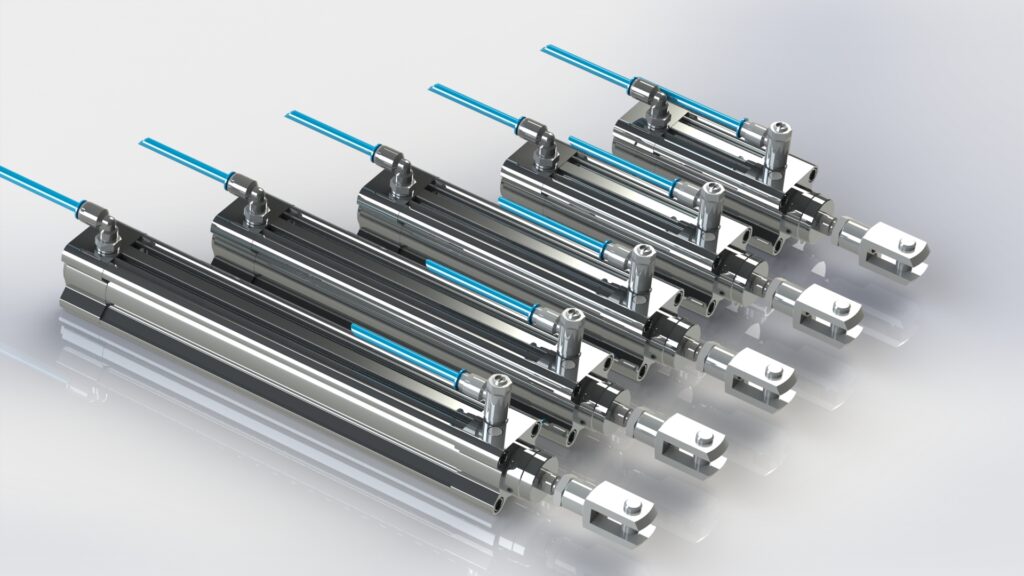
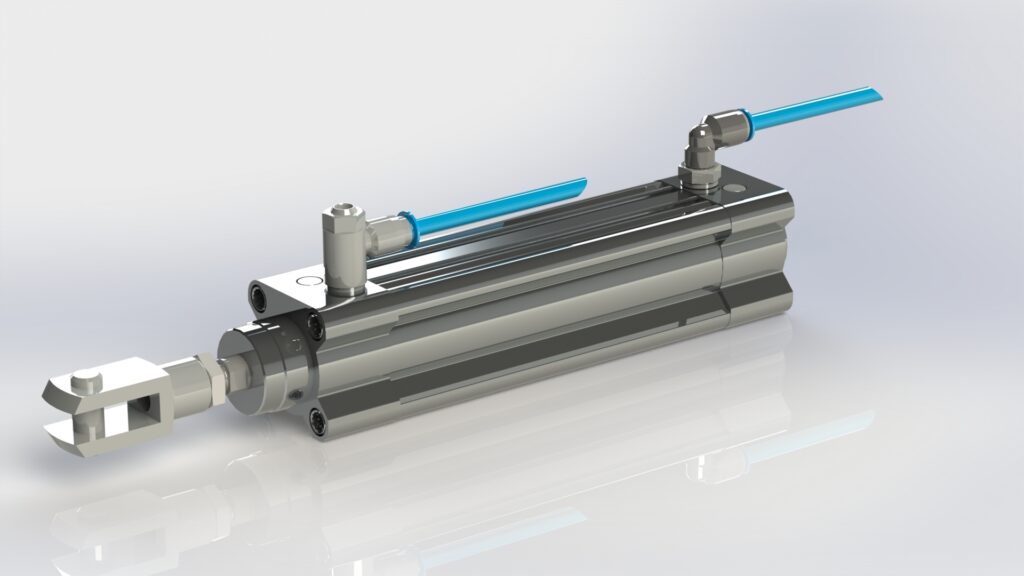
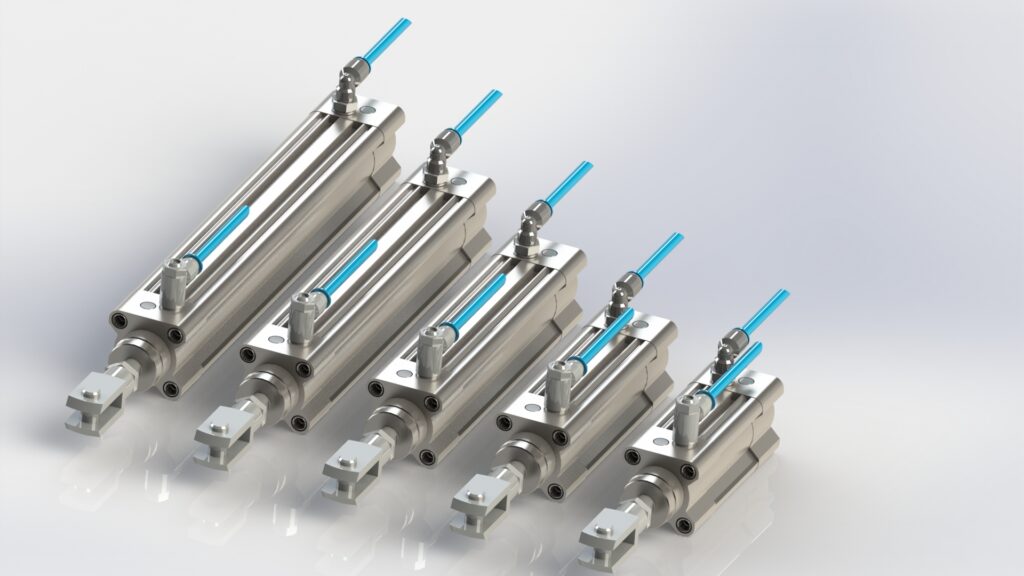
Festo piston cylinders are pneumatic actuators designed for linear motion. Whether it’s a round cylinder, profile cylinder, compact cylinder, short-stroke cylinder, flat cylinder, miniature cylinder, screw-in cylinder, or stainless steel cylinder: depending on the piston diameter, a thrust force of up to 50 kN at 6 bar is possible. Certain cylinders are also suitable for explosive atmospheres in accordance with the ATEX directive or are made of corrosion-resistant stainless steel with a housing design that is easy to clean.
Pneumatic Cylinders
Pneumatic Cylinders — These are components that are driven by compressed air, which is why they are also referred to as compressed-air cylinders. Pneumatic actuators are a particularly cost-effective solution for a wide range of applications—even under the most challenging environmental conditions—and are characterized by exceptionally simple commissioning. Speeds ranging from 10 mm/s to 3 m/s can be achieved. Pneumatic cylinders are robust and flexible due to the compressibility of air, which makes them resistant to high external forces.
Use of Pneumatic Cylinders
Pneumatic Cylinders They are used in numerous applications in automation and factory automation. Typical applications for pneumatic actuators include: clamping, lifting, lowering, pushing, pulling, feeding, rotating, gripping, clamping and holding, joining, stopping, stamping, embossing, and others.
Festo Pneumatic Cylinders
At Festo, the range of pneumatic cylinders includes rod-type cylinders and rodless cylinders (linear actuators), rotary cylinders, tandem cylinders, multi-position and locking cylinders, as well as clamping and tensioning cylinders, actuators with linear guides and bellows, and gas-spring cylinders. Among these, we offer many standard pneumatic cylinders with standardized dimensions and mounting interfaces. Based on these dimensions, the pneumatic cylinders are identical to the standard versions. There are standards for round pneumatic cylinders (ISO 6432), compact pneumatic cylinders (ISO 21287), and profile and stud-type pneumatic cylinders (ISO 15552).
Piston-type pneumatic cylinder
Festo Pneumatic Cylinders – These are pneumatic actuators designed to perform linear motion. The force applied to the piston is transmitted through the piston rod to the moving components. Piston-rod pneumatic cylinders are available as round cylinders, profile cylinders, compact cylinders, short-stroke cylinders, flat cylinders, miniature cylinders, threaded cylinders, or stainless steel cylinders.
Rodless pneumatic cylinders
Rodless pneumatic cylinders are pneumatic cylinders and, as the name implies, do not require a piston rod. However, even without a piston rod, they perform linear motion, which is why they are also called linear actuators. Rodless pneumatic cylinders are primarily used in applications involving long travel distances, for example, as the main drive in a multi-axis gantry or for feeding tasks.
Rotary Actuators
Pneumatic rotary actuators / rotary actuators from Festo provide rotary motion up to a rotation angle of 270°. With rotary vane or rack-and-pinion drives: maximum precision is just as characteristic as high performance and a wide variety of drive options. Our pneumatic actuators are used in a wide range of industrial automation sectors.
Rotary actuators
Tandem cylinders, high-power cylinders, and multi-position cylinders
A tandem cylinder consists of two identical profile tube cylinders arranged side by side to double the thrust in both directions of movement. A high-power cylinder is a type of cylinder defined by a series of compact pneumatic cylinders. Pneumatic multi-position actuators are available as a version with two separate cylinders and as a version with two to five cylinders connected in series.
Tandem pneumatic cylinders, high-force pneumatic cylinders, and multi-position pneumatic cylinders
Pneumatic cylinders with guides
Festo pneumatic cylinders with guides — actuators with guide rods and linear guides—are pneumatic actuators and among the “workhorses” of industrial automation. Here you will find a wide range of applications in areas such as lifting, pressing, pulling, pushing, clamping, stopping, holding, cutting, separating, and much more. Both types of guided cylinders combine the advantages of linear motion with those of a guide and are characterized by particularly high stability.
Pneumatic cylinder with guides
Stop Cylinder and Feed Separator
With its separators, Festo offers solutions for material handling systems worldwide. They simplify the workpiece feeding process and are used when continuously arriving workpieces need to be separated and individually transferred to a downstream device.
Pneumatic stop cylinders are pneumatic cylinders used for cushioned or non-cushioned stopping of movements in machine tools or workpiece holders on conveyor systems. In conveyor systems, shock-absorbing stop cylinders can stop objects weighing up to approximately 800 kg.
Stop cylinder and feed separator.
Clamping cylinder
Clamping cylinders hold or clamp workpieces either directly via a pneumatic clamping element or via a kinematic mechanism. When inactive, the clamping element retracts from the work area. Kinematic mechanisms can be used to achieve very high holding forces with low energy consumption.
Clamping cylinder
Bellows pneumatic cylinders and pneumatic actuators
Bellows and diaphragm actuators form a class of their own in the world of pneumatics with unique properties. For example, they do not exhibit a slip effect. They can be used in various ways as drive elements or pneumatic springs.
Diaphragm and pneumatic actuators
Rotary multi-position tables
Continuous rotary movements can be achieved using pneumatic indexing tables. Rotary indexing tables are used, for example, in assembly applications. The variable direction of rotation and freely selectable indexing intervals ensure a wide range of possible applications.