SMART CHOICES AND COST REDUCTION
Compressed air treatment is an essential step in the operation of any industrial pneumatic system. The treatment process involves removing various types of impurities from the air in the form of solid, liquid, and gaseous contaminants, such as dust, condensate, scale, compressor oil, wear particles from pneumatic equipment, and other contaminants. In addition, treatment includes pressure regulation and smoothing out pressure fluctuations, and, if necessary, supplying lubricant to pneumatic devices.
The use of untreated compressed air can lead to damaging consequences for equipment, downtime and breakdowns, and disruptions in the production process. Global experience with pneumatic systems shows that 80% of malfunctions are caused by insufficient air purification. The losses from unplanned repairs and production downtime can significantly exceed the cost of installing compressed air treatment equipment.
Compressed air supply systems are found in virtually every industrial facility, regardless of the industry. Air quality directly affects product quality. The main sources of contamination are considered to be mechanical particles present in the source air, as well as the formation of moisture droplets on the walls of the air lines as they exit the compressor.
Condensate in the compressor is one of the common causes of unstable system operation, oxidation, valve freezing, and paint blistering on the parts being processed. The greater the distance from the compressor to the tool, the more moisture accumulates along the line. To ensure uninterrupted and high-quality system operation, it is necessary to maximize the purification of the compressed air preparation system by using special filters and dryers.
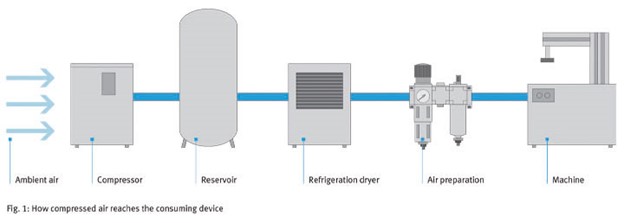
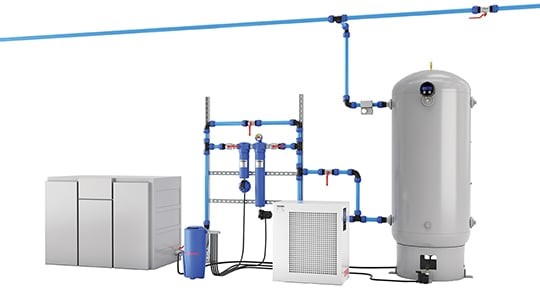
Typically, the system consists of several preparation stages, such as:
1. Compressor — this is where it all begins; it can be a piston or screw compressor, used to compress air. The amount of condensate produced—which must subsequently be drained from the system—depends on the type and installation location of the compressor. Therefore, the primary task is to remove moisture from the compressor. Timely maintenance of the filters will help reduce equipment wear and tear.
2. Compressed Air Cooler, It is designed to lower the temperature of the compressed air as it exits the compressor. This is an equally important process, since the temperature of the air exiting the compressor is very high.
3. Compressed Air Separator — a direct air purification device that separates moisture generated in the pneumatic system. It operates on the centrifugal principle, ensuring high efficiency and removing up to 99% of moisture and aerosols from the working environment.
4. Thermodynamic steam trap — A device for draining accumulated condensate at each stage of the air preparation system. These devices can be automatic (based on fill level), semi-automatic (draining at a preset time), or manual.
5. Horizontal air intake It is a multifunctional unit. It smooths out the pulsations in the air that the compressor feeds into the system. It also stores compressed air, which ensures smooth operation of the working component.
6. Compressed Air Filter. There are numerous manufacturing variations, which depend on the source. Generally, there are two types of filters: a coarse filter, which filters out particles up to 10 µm, and a pre-filter, which captures impurities up to 5 µm in size.
7. Dehumidifier Designed to remove moisture from the compressed air to the desired dew point. The principle of operation is as follows: when air enters the cooling distribution system, the vapor condenses into liquid. For example, at a temperature of 24 degrees and a relative humidity of 74%, a standard unit with a capacity of 19 m³/min produces 160 liters of water in 7 hours—this is without an aftercooler. With an aftercooler and a moisture separator, up to 50 liters of moisture enters the system.
8. Primary Filtration Filter — captures microparticles as small as 1 μm and oil contaminants up to 0.1 mg/m³.
9. Fine-filtration filter — It captures solid particles as small as 0.1 µm and oil particles at concentrations of up to 0.01 mg/m³.
10. Charcoal Filter — A filter for the food industry that traps odors.
11. Moisture-Oil Separator It separates the condensate droplets drained from all system components and separates the oil, allowing the water to be drained into the sewer system.