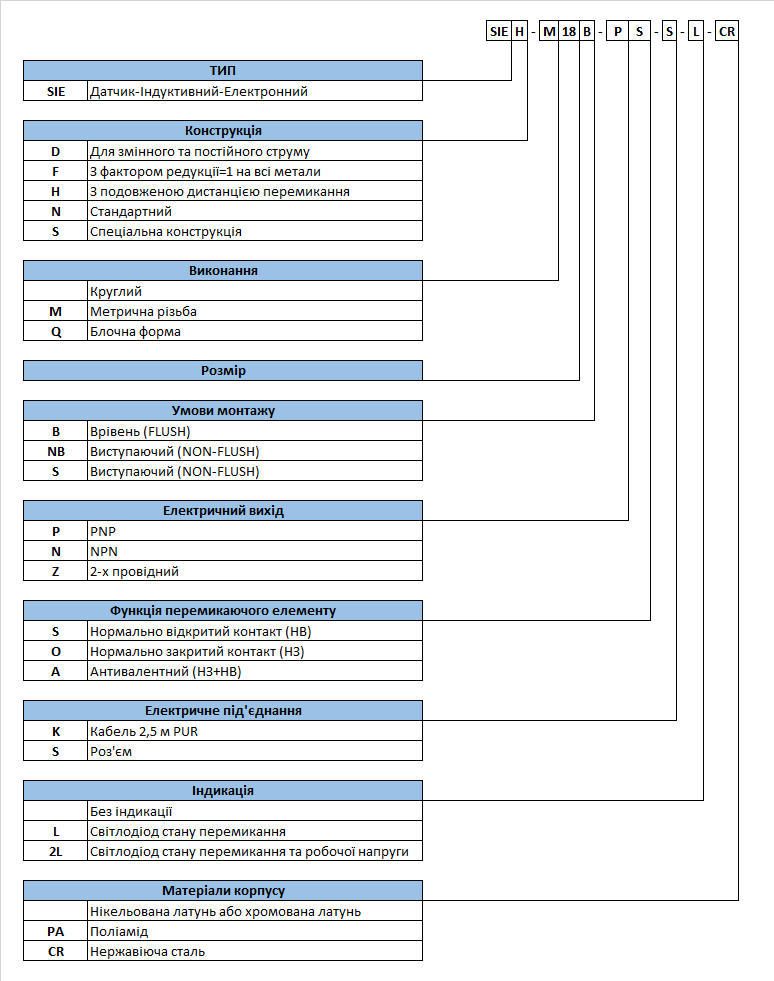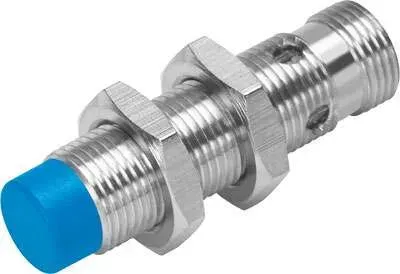
Let’s take a closer look at what an inductive sensor is.
In today’s world, where technology has become an integral part of everyday life and industrial processes, inductive sensors play a key role. These unique devices, which utilize electromagnetic principles, have become indispensable in the automation and control of various technological processes, ensuring accuracy and efficiency in measurement and control.
Inductive sensors are signal generators that respond noncontact to the functional movements of the working parts of machines, robots, conveyor systems, and the like, generating electrical signals.
These signal generators have the following specifications:
- Inductive sensors detect all conductive objects that pass through or remain within the high-frequency magnetic field generated by a built-in oscillator.
- Індуктивні датчики працюють за принципом наближення, тобто об’єкт не надає на них механічного впливу.
- Inductive sensors do not require mechanical sensing elements such as rollers, cams, or levers.
- Inductive sensors operate without mechanical electrical contact and are controlled electronically.
This offers the following benefits:
No mechanical wear, resulting in a longer service life
• Non-contact operation;
• No malfunctions due to contamination or burnt-out contacts
• No contact noise or false triggers
• High switching frequency—up to 5,000 Hz
• Vibration resistance
• Any installation orientation
• Fully sealed with a high degree of protection
How It Works
Inductive sensors work by detecting metal objects in the immediate vicinity of the sensing element. They are not sensitive to other materials. Different sensors may have different detection ranges. This depends on the specific sensor’s design and the type of metal to be detected. Each manufacturer typically specifies these parameters in the technical documentation.
Today, the market offers a wide variety of inductive proximity sensors, which differ from one another based on specific criteria. Despite this, they all share a similar design and operating principle. The figure shows the general structure of a proximity sensor with an inductive sensing element.
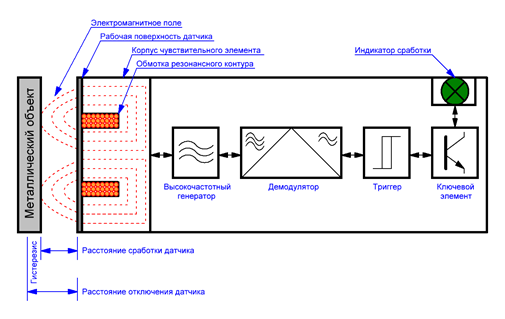
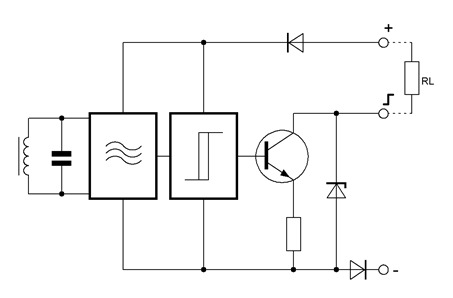
As shown in the figure, a high-frequency generator creates an electromagnetic field in the coil of the sensing element. When a metal object approaches the sensor, the parameters of this field change, and this change is then detected by the trigger circuit. The trigger output controls a switching element capable of switching a small load, such as a relay or other similar devices. Most sensors are also equipped with an LED indicator to signal activation. This approach allows you to verify the sensor’s functionality and calibrate it during installation. The diagram shows one possible circuit implementation of an inductive proximity sensor.
Output Types
Inductive proximity sensors can have different circuit designs for their output stages, which is sometimes a deciding factor in the selection process. The following types of outputs are available:
A standard N-P-N transistor output; NPN
A standard P-N-P transistor output; PNP
Relay output—primarily used in large sensors. A key feature of the relay output is the galvanic isolation between the sensor’s power supply circuit and the switching contacts, which allows the load to be powered by any voltage.
The Difference Between N-P-N and P-N-P Configurations
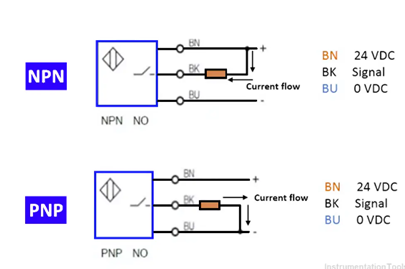
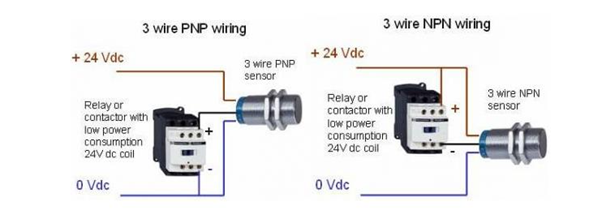
As mentioned earlier, inductive proximity sensors with a transistor output can have different conductivity types (N-P-N or P-N-P). The difference between these sensors lies in which poles are switched through the load. A sensor with a P-N-P output switches the positive power supply terminal, while an N-P-N sensor switches the negative one. This is illustrated more clearly in the diagram:
Sensors with Kf=1
Standard Inductive Sensors
As we saw above, standard detectors consist of a coil with a ferrite core and an electrical generator that creates a magnetic field. This design is prone to a reduction in the operating range when a non-ferrous metal object is detected. This factor depends on both the sensor’s design parameters (such as the housing material) and the material of the damping element. In certain applications, this behavior can have a detrimental effect or create challenges in sensor selection and placement, as well as necessitate the use of multiple sensors to detect various metallic objects. This has led to the development of specialized inductive sensors designed to mitigate the attenuation effect.
Inductive sensors with a correction factor of Kf = 1
Sensors with a factor of 1 are inductive sensors equipped with a special type of oscillator. They feature two coils with air cores at the center, which are electrically connected and ensure that the attenuation factor is precisely adapted to the characteristics of the respective material. As a result, the material of the object no longer plays a role, since the same sensor can detect all metals within the same detection range.
Among the few manufacturers of this type of sensor, Festo offers sensors with a correction factor of Kf=1 in its product line under the name SIEF-…
Advantages of SIEF sensors over standard models:
1) Smaller dimensions to achieve the same switching distance for non-ferrous metal objects;
2) Not susceptible to the effects of external AC and DC magnetic fields;
3) Increased switching speed;
4) A wider range of ambient temperatures;
Major manufacturers of inductive sensors
An Overview of Leading Manufacturers of Inductive Sensors: Innovations and Key Features
Inductive sensors, which play an important role in the field of automation and control, are supplied by various manufacturers, each of which incorporates unique technologies and innovations. Let’s take a look at some of the leading manufacturers of this type of technology and the key features of their products.
1. Siemens AG:
- Innovation: Siemens offers a wide range of inductive sensors that utilize cutting-edge technologies in the field of electromagnetism. Their products often include remote monitoring features and the ability to integrate with industrial automation systems.
2. Turck:
- Innovation: Turck is known for its innovative solutions in the field of inductive sensors. The company is actively developing technologies to extend operating ranges and increase resistance to external influences, making its products reliable even under challenging conditions.
3. Pepperl+Fuchs:
- Innovation: Pepperl+Fuchs specializes in inductive sensors for use in potentially explosive atmospheres. Their products ensure a high level of safety and comply with the strict regulations and standards applicable to these environments.
4. Balluff:
- Innovation: Balluff focuses on developing smart solutions in the field of inductive sensors. Their products can integrate with Internet of Things (IoT) systems, providing additional monitoring and analytics capabilities.
5. Omron Corporation:
- Innovations: Omron offers inductive sensors featuring advanced signal processing technologies, ensuring high accuracy and stability in measurements. Their products also often include adaptive self-diagnostic functions.
6. Banner Engineering:
- Innovation: Banner Engineering is known for its innovations in the miniaturization of inductive sensors. Their products deliver high performance in a compact size, which is important in confined spaces. Each of the manufacturers listed contributes to the development of inductive sensors by providing the market with a diverse range of technologically advanced products. Buyers can choose from a wide range of solutions tailored to the specific needs and requirements of their manufacturing or technological tasks.
SUMMARY:
In a world of innovation and productivity growth, Festo strives to keep pace with cutting-edge technologies. In the inductive sensor manufacturing segment, the company has focused on standard sensor models, which leads to larger-scale production and, as a result, lower costs. Most standard inductive sensor models from other manufacturers have a counterpart in Festo’s product lineup.
FESTO Sensor Designations