
SERVO-DRIVEN EQUIPMENT
GET ADVICE ON SELECTION, PRICE, AND STOCK AVAILABILITY
Servopneumatic Positioning Systems
Servo-pneumatic positioning systems consist of the following components: namely, a cylinder with a position measurement system, a proportional control valve, and a positioner. Servopneumatic positioning systems are used to move a pneumatic cylinder to a specified target position in position control or to generate a specified target force in force control. Festo is a global market leader in servopneumatic systems and offers the right solutions for your requirements.
How Servopneumatic Positioning Systems Work
Servopneumatic systems use compressed air, which is why they are considered particularly “gentle.” This is because once the actuator is locked in position, it can be moved or pushed back only by a correspondingly large external force. From a cost perspective, servo-pneumatic positioning systems are particularly attractive when masses exceeding 10 kg need to be moved.
Components of Servopneumatic Positioning Systems
Position Measurement Systems
Position measurement systems are an important part of servo-pneumatic positioning systems, as they provide the actual value of the current position. The cylinder diameters of Festo’s displacement systems range from 18 to 100 mm, and the stroke lengths range from 100 to 2,000 mm. Festo’s position measurement systems are available in both rotary and linear versions.
Position Measurement Systems
Proportional Valves
Proportional directional control valves are used in servo-pneumatic positioning systems as actuators that regulate speed using built-in pressure sensors. Festo offers three different types of proportional valves that can be controlled analog, digitally, or directly.
Proportional Distributors
Positioner
Two Festo positioning controllers, also known as axis controllers, are suitable for servo-pneumatic positioning systems. Actuators controlled by the high-speed Soft Stop CPX-CMPX move smoothly and without impact to their end positions. The CPX-CMAX was developed for simple servopneumatic control of a variety of pneumatic linear or rotary actuators.
Electric Cylinders and Carriages
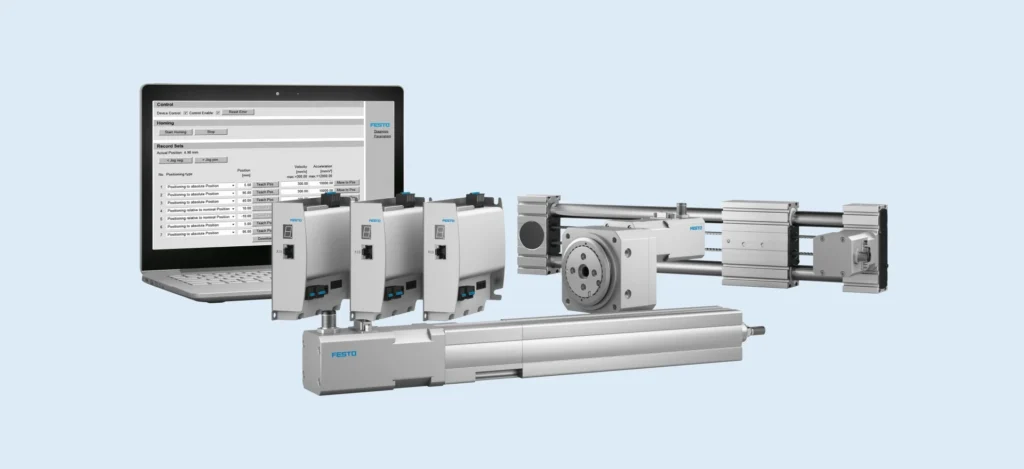
With Festo electric cylinders, you can use a linear actuator with a rod to generate the required force and speed, enabling you to perfectly implement various work processes in your system. Our compact electric cylinders with guides are also designed for a wide range of applications across various industries. In our product range, you’ll find a wide selection of different electric cylinders and mini-axes.
Definition of an electric cylinder
Electric cylinder This is an actuator that performs linear motion using a servo motor or a stepper motor. It consists of a ball screw and a rod that extends and retracts, creating linear motion similar to that of a pneumatic cylinder. Electric cylinders can be used in a variety of applications, such as assembly, packaging, and other areas of manufacturing automation, as well as in robotics and material handling.
Difference: Electric Cylinders and Pneumatic Cylinders
Unlike pneumatic cylinders, which use compressed air, electric cylinders use electric motors to generate linear motion. Electric cylinders, also known as electric actuators, are generally more precise and offer better motion control than pneumatic cylinders. Electric cylinders also have the advantage of being quieter than pneumatic ones. Pneumatic cylinders use pressurized air to create motion, which can produce a hissing sound as the air is released. In contrast, electric cylinders generate motion almost silently using electricity.
Applications of Electric Cylinders
Electric Cylinders have a wide range of potential applications in various sectors, such as assembly, packaging, and manufacturing automation, as well as robotics and material handling. In robotics or material handling, a linear actuator can be used to move, align, and manipulate objects. In manufacturing automation, a linear actuator can be used to automate tasks such as assembly and packaging (for example, a part can be moved into the correct position for assembly, or a product can be picked up and placed into a packaging container). On the other hand, in material handling, the drive can be used to move and position objects in warehouses and other environments (for example, to move a pallet of goods from one location to another or to adjust the height of a conveyor belt).
Definition of Electrical Axes
Electric axes – These are devices that convert the rotational motion of a servo motor or stepper motor into linear motion. The electromechanical system consists of a motor, a lead screw or ball screw, and a carriage that moves along a guide rail. Linear axes are often used in applications that require precise, controlled linear motion, such as in material handling or robotics, in machine tools or factory automation, in assembly applications, or in the packaging industry.